FROM THE COMMUNITY COLLECTION
Planet Hadess
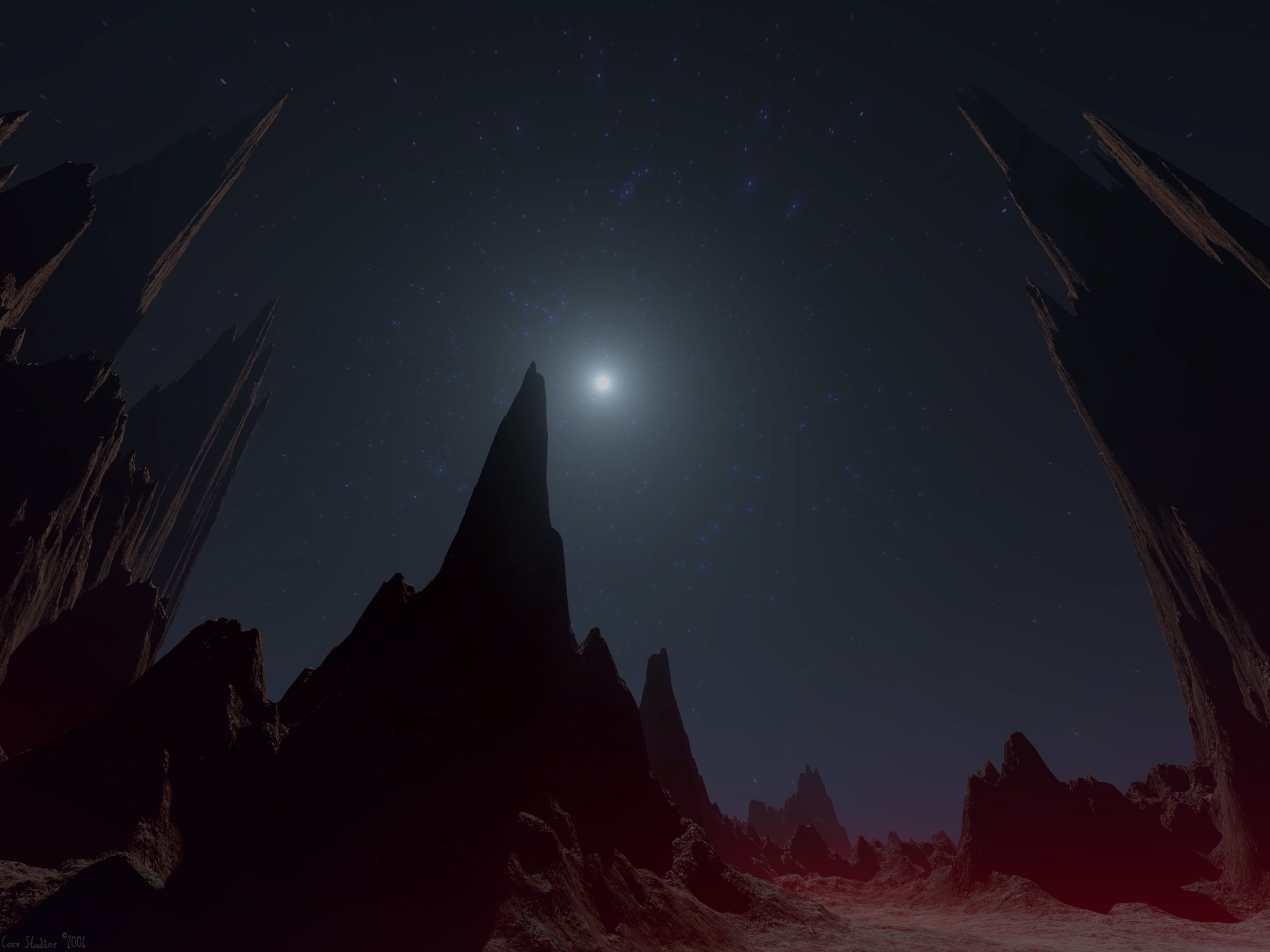
A distant place in our universe. When storms are raging, the red toxic dust on the surface emits in space and thus prevents the planet from being fully discovered. Hypothetic suggetions led people to give the "Red Fog", as they often call it, the name Hadess. The bright star you see isn't the Sun. Our Sun could be one of the other "tiny" stars surrounding it (speaking of size :)) ~ Hope you like it ~ 1. Rendered the landscape in Terragen; 2. Rendered the stars with same resolution in Bryce; 3. Merged the both layers in Photoshop;
Loading unique views4,199 unverified legacy hits5.0 archived rating2006-04-22 added
Comments 7
A conversation around the artworkSign in to join the conversation.
You liked it :), thanks for all your remarks! I have to admit my limited knowledge about the stars and planets. I'm just aware of a few things which turned out to be useful creating this scene. I have much learn though. About the banding - I thought I'm the only one to see it...apparently not:( and I believe LitoNico is right. The main render was done in TG which means the main layer I worked with is messed up. Even registered I couldn't find a dithering option to prevent that happen. Perhaps the Pshop will help with a bit of playing. Plan "B" is to wait for the official realease of TGD Alpha.
The banding, I think, is a problem with Terragen's rendering engine- I know my computer's screen (and graphics card) can produce those colors, and in Bryce I've never had a problem with it. When I wonder about my monitor's capabilites, I tend to take a banded image into Photoshop and blur it a great deal. It you still have the banding, It's the computer. To solve this, I know of no way other than finding a dithering option in terragen.
Well, speaking as the astrogeographically ignorant, I never expected an icy surface, really I'd not given it much thought, but since you have drawn my attention to the atmosphere I would point out that the banding in dark colours is a bit of an issue - I turn on 48 bit dithering to try and combat this but any sort of compression, gamma or JPG, seems to bring it right back out again. I wonder if there are any good solutions to this problem? Is it down to the colour depth the images are stored at or down to the CRT's and Flatscreens we use being unable to reproduce fine gradations in the dark areas of the spectrum? Or given that CRT's are analogue driven devices, does the problem lie in our graphics cards?
Misunderstanding No, no. I didn't mean you've got the astro geo- or eco- or any- logy wrong. LitoNico is quite right. What I wanted to say is that we (well, it's probably only me) usually expect icy surfaces but in the absence of an atmosphere, water, methane or whatever has long gone, if there ever was any. Though, the halos around the stars do suggest a bit of an atmosphere. It might be warm enough here to have any liquids evaporated or flowing in creeks and rivers not seen here, behind the mountains. This is a plausible picture, nothing wrong with it.
Good work compositing the two images. I like the image overall even if, as Horo has tactfully pointed out, you've got your astro geography all wrong. Never mind, still worth 5/5 in my book.
The more I look at this, the more I like it. In disagreement with Horo, I would think (with my limited knowledge of planetary ecology) that with no water and probably little carbon, there would be no ice. As a suggestion, you could render the same terragen scene woth the sun facing the opposite way and no atmosphere. Then, you could screen it over the rest of the scene, and have some detail in the shadows. Great job, anyway.
Very nicely done, good story. For such arid planets this far from their sun, you would expect to see a lot of ice. I like your deviation from the standard expectation.