FROM THE COMMUNITY COLLECTION
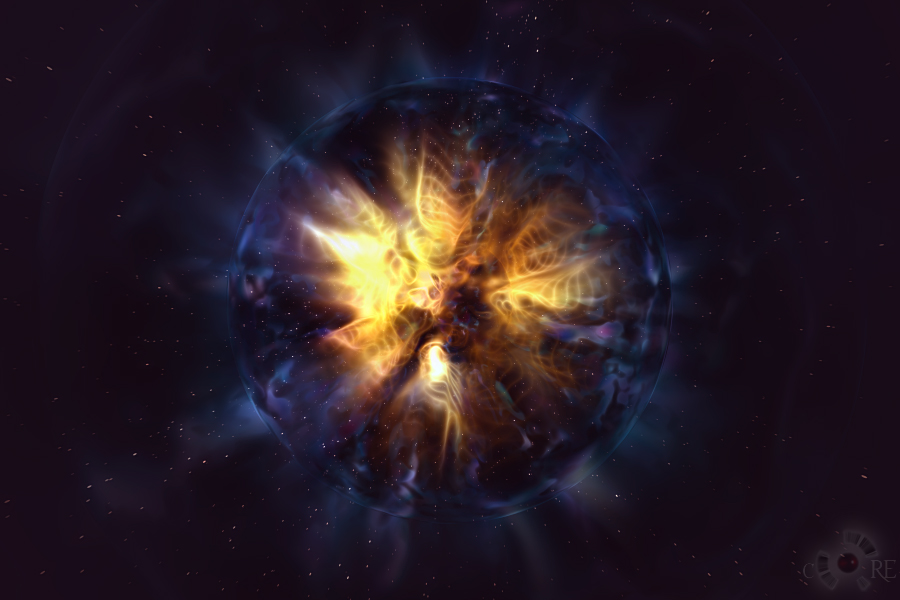
V-12 Self Destroyer
This... was a bomb. A very big one. The scientists of Vivid-12 have created the ultimate weapon of destruction, a little "gift" for the Carva friends. Once launched and detonated V-12SD can literally "cut" our moon in two, what's more -- it can disable any electric-based devices in very large range. The last one is caused by the electro-magnetic pulse you see here in blue and puple nuances. For this render I used few spheres with David's plasma material on, the FOV was rolled up to 180, custom starfield with 15000 stars shining at 99 intensity. All 100% bryce-made. Hope it turned well!
Loading unique views3,999 unverified legacy hits5.0 archived rating2006-08-12 added
Comments 5
A conversation around the artworkSign in to join the conversation.
Does not matter what it is supposed to be, this would look good on anyones desktop! Pleaseing balance of light and dark, detail and emptyness. Excellet piece. 5/5
Generally I wanted to avoid, to escape the bounds of how a real explosion would look like. I wanted to create something futuristic with similar but not the same effect as we used to see or imagine. It was a bold one I admit. Maybe I should've stayed at least partly bound to physics & reality. The good thing now is that this was a test #1 in V-12's team - open space, clean kaboom, no such thing as casualties or damaged devices, just gently squeezed trigger and modern fireworks :) I'll try to change a serious part of this img and really hit something this time. If I'm to prepare the "intro" to the fourth Colony img, so it has to be more then a single test-blow in space. Thank you for the vote and comments. Now to the point: the spheres ARE within one another. You're unable to notice any collisions, because: (1) the blue-purple spheres ouside the "orange" are side-rotated with low density and that makes them look almost transparent in the middle. This means if there are any collisions, they are just as invisible where objects should touch; (2) if in some way such dreadfull collisions are evident here and there, the magical number 180 for the FOV "washes" them off in our perspective, leaving interesting purple traces near the sides of the img. These are possible to be unseen too on darker monitors. Well, stay tuned for the next entry and 10x for watchin :)
I like the colour composition very much but fail to see the light of an explosion in this. Not at least for the reasons radash outlined. White - blue - red from the inside to the outside would be more physically correct. Hovever, I don't know how it would look like usig anti material ... Though I like the form as such, it looks to even for an explosion, which is usually not only something catastrophic but also chaotic. I miss some chaos at the edges. The ?motion blur? of the stars Lito refers to come from the large FOV. Nevetheless, it nicely fits here. Again, a beautiful picture, but in the wrong context.
violence and beauty! Nice shock waves effect. Very 3dimensional. Terrific color balance between warm and cold colors. You're an outer space and physics buff like I am, so I can go to the next level technically with you and you will probably see my point. Usually in nature, blue gas is hooter than red gas. It might be interesting to see what happens if you invert the color choices. The center should be a hot blue that will "cool" to an orange on the edges like a pilot on a stove. Also, at the center point of the explosion, the intensity of the heat and light being radiated should still be well mixed and appear pure white, at least for a few pixels, before splitting into individual colors. A bit of pure white at the center with some intense white rays will raise the "temperature" of the explosion and the overall contrast level of the image. Also, the power of this bomb could be made even more clear if there was a nearby planet or moon that was illuminated by the light of the explosion. The more the elements of a scene interact with one another, the more realisticc the image becomes. The description says that his bomb could destroy a moon. That statement would be self evident and if there was a moon in the pic that was being affected by the bomb at least in terms of illumination. We could also see from the cirucumferences of the moon and the explosion cloud itself clearly that this bomb was no joke. Lastly, I think i can answer LitoNico's question regarding volumetric fracture lines. I deal with the same issues in my skies and nebulas and one answer is volumetric layering. I can't be sure of course, but I suspect the magic he used was to place the volumetric spheres in front of one another, not within one another. All in relation to our viewing perspective. This way they never actually touch, yet they look like one object. I do the same with volumetric clouds in landscapes using many clouds to "look" like one. Awseome image Richter.
Very nice blending effect between the purple and the plasma, I'm wondering how you avoided the volumetric collisions there. The stars look very nice, especially the slightly motion-blurred ones at the edge. Overall a very good image- you've got a five from me.