FROM THE COMMUNITY COLLECTION
HdriSpecularity
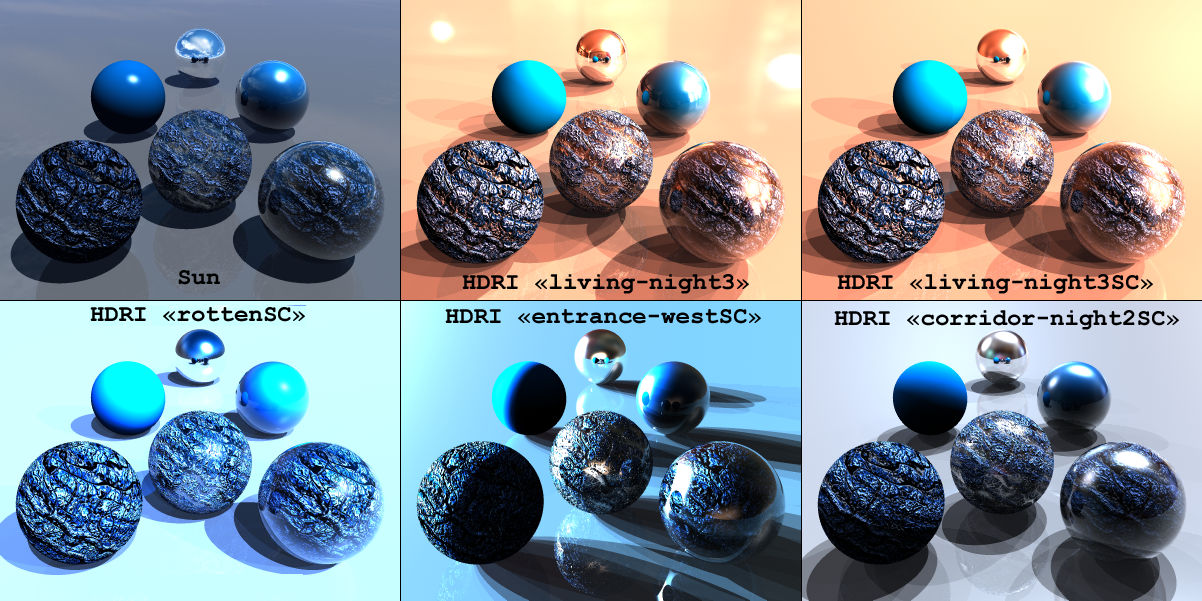
The sequence compares icecreamman's coating method to simple reflection. As can be seen, bumpy materials become flat when using a glass coating. Depending on the HDRI and material used, second reflections can appear, even though the coating is only 0.01 BU larger. Although the coating has Reflection set to 0, darker parts act as a mirror. All spheres have Diffusion, Specularity and Refraction set to 100. The 3 spheres in front have bump set at 100. The middle one has Reflection at 50, the right one has a glass coating. The blue spheres have the same settings, except there is a blue material and no bump applied, the right one features a coating. The sphere at the back is a mirror ball. The groundplane has the default Bryce grey applied, Diffusion at 75, Transparency and Reflection at 10 and Refraction at 100, all other channels at 0. The HDRI-names with a trailing ?SC? were specular convolved with a Phong exponent of 50. Though icecreamman's tests are very interesting, I think Reflection is the way to go to give an object lit with a light probe a quality of specularity. After all, this is more real.
Comments 6
A conversation around the artworkSign in to join the conversation.
Interesting and informative, and also a curiously appealing image all on it's own!
Thanks so much Horo. It means alot that you are willing to share what you could make a fair amount of money on. Thanks for what you do. Your HDRIs are wonderful!
Living-Night3.hdr This probe has the white balance wrong but I was also surprised how nice the colours are. I do not plan to make this HDRI available for the general public, but I'm ready to share it with bryce5.com regulars. It is temporarly available under this link http://www.horo.ch/xchg/LivingNight3.zip for a few days.
. I have to say that I like Bryce's IBL vs Carrara's Sky Light much much better. There is more bump, no soft shadows, more accurate lighting. Great tests!
The results do not surprise me at all. Reflection is the only tool we have in IBL situations. Notice how brightly the hdris are set. The more grand the bright spots in the hdri, the more likely it's reflection will appear as specualrity.
Man Horo, that living night hdr is wonderful... Is there any way I could get a hold of that? I think the only way to really sucessfully use a gloss coat is as a layer to a material, using layered materials in programs such as Vue is a possibility, but as a seperate object, it doesn't work terribly well. Hmmmm, I wonder how well gloss coats would be with simulating fresnel effects. :) Thanks for your tests horo.