FROM THE COMMUNITY COLLECTION
IBL Background
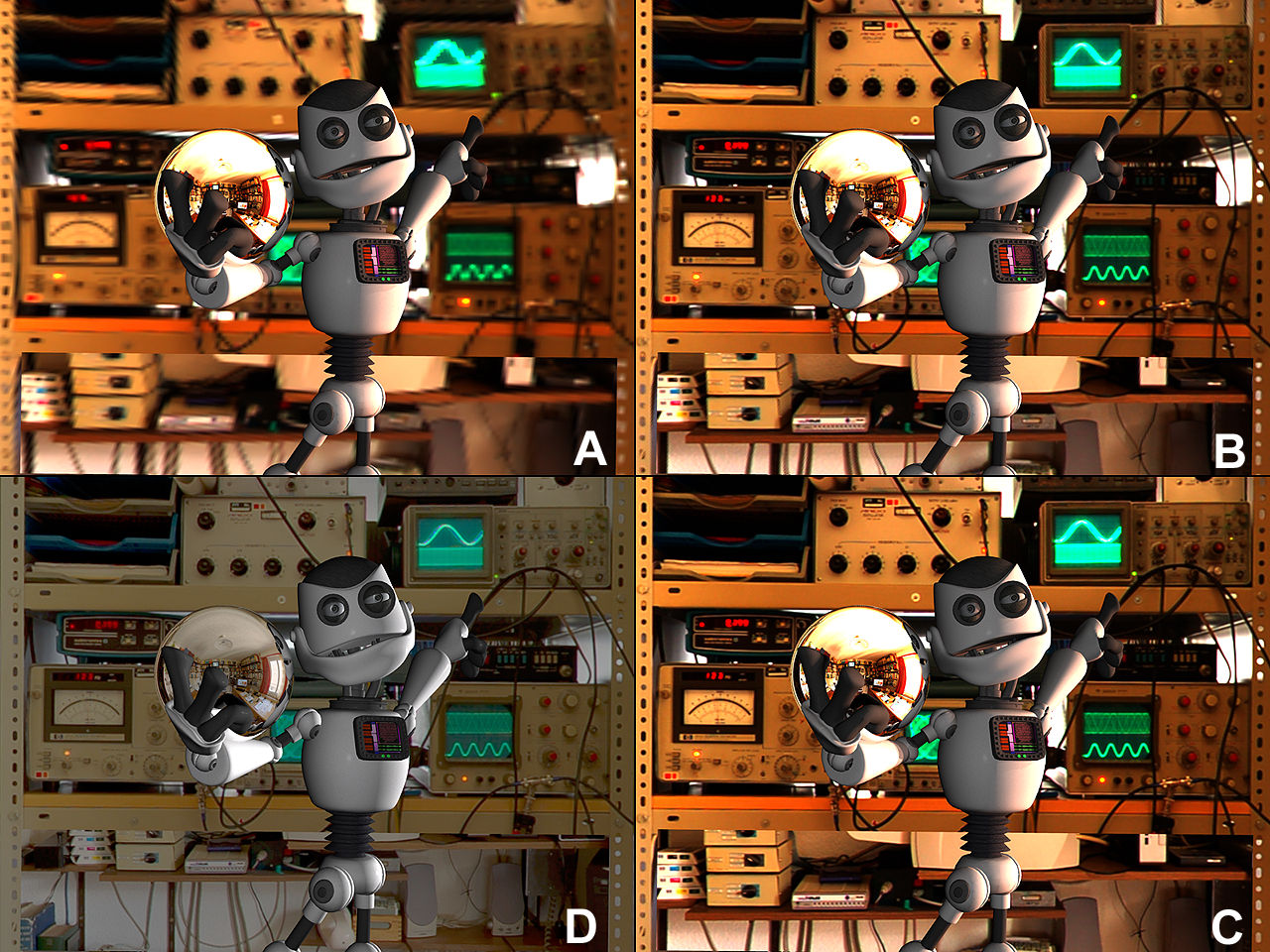
Rendering the HDRI as background is always a bit of a disappointment. It doesn't look right. The problem is not the resolution as we usually think, it is the unappropriately tone-mapped LDRI. The base of this demonstration is a spherical panorama I made from 56 photographs. From the resulting 8436 x 4218 pixel HDRI I created 3 light probes for Bryce and a tone-mapped spherical representation to map into a sphere. The Chomper ist from DAZ3D, the scene is lit by the HDRI (A, B and C). For D, a single radial instead if the HDRI lights the 10'000 x 10'000 x 10'000 BU sphere with the tone-mapped LDRI. A radial at the camera location brightens up black shadows in all 4 renders. The diameter in pixels of the light probes are: A=1280, B=3840, C=6400. The horizontal camera FoV is exactly 38? (set to 47.5? at 100% size). The difference in resolution between A and B is obvious enough, between B and C less so but can still be seen. The resolutions of C and D are identical since the number of pixels are almost identical. But D looks much better, because the Bryce tone-mapper doesn't really make a good job. Just look at the window in the mirror ball: burned out in C, landscape visible in D.
Comments 8
A conversation around the artworkSign in to join the conversation.
Picture "D" I like the most :)
I will ask you more questions on this in the forum. Thanks
RenderMan - to put it in a nutshell: LDRI stands for Low Dynamic Range Image, i.e. a conventional 24-bit per pixel picture while a HighDRI has 96-bit per pixel. Since an HDRI cannot be represented on paper or screen (except for the new experimental HDRI monitor from Greg Ward), we need to adapt the high dynamic range to the conventional low dynamic range. The process is called tone-mapping. There are about a dozen different tonemapper which have up to over a dozen controls to adjust high-lights, shadows, saturation, etc. and there are global and local ton-mappers. A global one affects the whole picture while a local one affects parts of the picture. A global tone-mapper gives more realistic results and the local one is better suited if you go for dramatism and art. A BU is a Bryce Unit, the unit of size for objects. A sphere defaults to 20.48 x 20.48 x 20.48 Bryce Units. To create the effect of D, you need a spherical panorama (LDRI) as material which you can map spherical or parametrical (the difference is 90? in azimuth) on a sphere. Having the camera inside the sphere shows the panorama with left - right swapped because it is mapped at the outside of the sphere. The panorama picture must be mirrored in a graphics app before you can use it. The HDRI in IBL is also mapped inside an invisible sphere with an "infinite" size (like the Bryce sun is at an infinite distance) but it is not infinite. If you bring a sphere very near to that HDRI sphere, you get interferences and that is how my Woolball2 HDRI (on page 2 in my HDRI resources) was made.
What ever you do don't forget to put in the dash on the Headline. I thought posted hours ago but when I came back it was blank. Horo my question has to do with the effect in D. It looks great. Then I was wondering how the average Brycer (me) could create the same effect. I know this Bryce or light language is common to you and some others but for me it is still foreign. I don't have a clue what a tone mapped LDRI is and I also don't understand what you mean by 10'000 x 10'000 x 10'000 BU? Oh and don't forget the light probes that is if you have time. I am not in a hurry as I still have other things to learn.
Aye, you seem to have hit the nail on the head. The difference is quite marked indeed. I know I've tried many times to incorporate the hdr background into an image, and more often than not, been disapointed with the results. The richness of the colours in the hdr background moreso than the lack of resolution is clearly (as you have demonstrated) the biggest issue. Excellent test, and nice work with the lighting in D!
RenderMan - what is it exactly you do not know how to do?
Big Difference The only question that remains is how can I do this?
wow This is an amazing test Horo. Very good to know and understand these ibl shortcomings. Yes when used as background most times the background do look off a bit. Wow. D looks great especially when you observe the landscape within the mirrored ball.