FROM THE COMMUNITY COLLECTION
Indirect lighting in bryce MKII
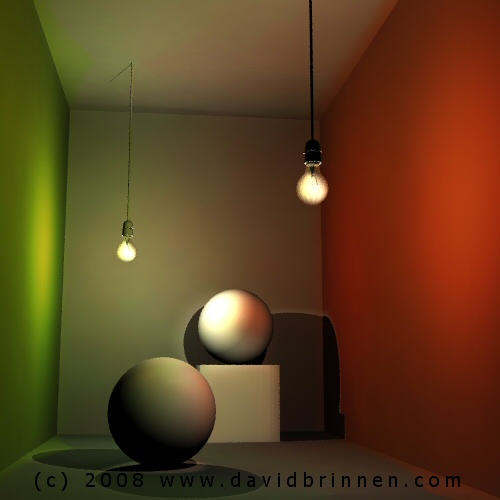
OK, this is going to be a bit of a noodle twister, but bear with me. I know it looks a bit ropey, but the final render took less than two minutes and is only lit by two lights. (four if you count the pair of squared lights illuminating the light bulbs - for effect). The walls and the primitives are bryce default grey the colour is from the main lights. Needless to say, the setting up of the lights is tricky. Initally, I placed the camera where the left hand light source is and rendered the scene panoramically, with no shadow casting and using the BSolutions trick of softened reflection and metalicy to create an illusion of bouncing light using only 4rpp. I took this render and blurred it in PSP8 and used it as a gel (spherically mapped) where the light is, aligning it carefully so that the gel cast the light image onto the objects that originally created it. Same for the right hand light. So the lights are colouring and lighting the scene according to previously gathered data. I then set the reflective materials to default grey to accept the colour passively. Set up took about two hours of experimentation and rendering total was about five minutes. Clearly there are imperfections, perhaps these can be overcome? Plus side is the technique is scaleable and not reliant on the geometry of the space it is contained in. Unlike the earlier method. It's a kind of inside out rendering. Please let me know if this is making sense. Thing is the issue of distortion from panoramic render (Horo maybe able to help here, in a 1:1 aspect, I found that the light source mapped to needed to be doubled in height) also a pain, the copy matrix does not copy the matrix center of the light to the POV of the camera. So I had to wiggle things around a bit and flip the x of the mapped image. Maybe I should have used a reflection map?... Anyhow, this is just throwing some idea's around for now to see if any of them have potential. I must admitt I'm pleased with the initial if crude results obtained from this because of the staggering speed with which this sort of (indirect-ish) light has been simulated.
Comments (0)
Sign in to join the conversation.
No comments yet. Be the first to leave a thought.