FROM THE COMMUNITY COLLECTION
3 Virtual Baked Lights
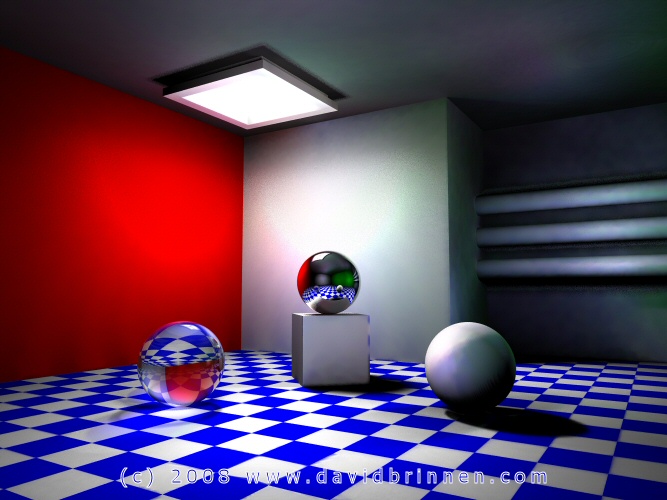
Here the scene is lit by three virtual lights and the most obvious main light (although the part the main light plays in the final render is less than might be apparant) the three virtual lights are hovering in space, one near the camera, one on the right and one under the light in the ceiling. The placement of these lights was chosen because they are points near the subjects of the scene and also would have plenty of light passing through them if this were a "real" environment. The ideal, would presumably to have the entire volume filled with mapped lights, or something like that. Here I make do with three. The scene took a couple of hours to set up. Rendering the baked light gels took three more and the final render took about eight minutes. In the gel renders I used the bsolutions fake ambient technique coupled with bryces own true ambient effect. This might have been a bit overmuch on the ambient and the ceiling and floor got a bit too much light and as a result I had to dull them down in the material in the final render. PSP8 was used to filter and composit the gel maps. It's all a bit fiddly I confess. On the other hand I'm pleased with the way the light responded to the chequered floor. And also this render shows a mirror and a glass ball and that these have not disrupted the gel maps. Greater accuracy in mapping was attained by doubling the size of the gel maps. Still there are minor errors that I can (and doubtless others) detect. So still not perfect in that respect.
Comments 6
A conversation around the artworkSign in to join the conversation.
I too find them difficult to use due to the opposite color hues. I think when restricted to greyscale the negative lights could be useful, but only if the positive shadows are disabled.
I do not doubt your ability to recreate this scenario. You have the patience and the skill. I would like to be able to turn the process into a step by step method that can be applied with minimal input from the user. That's going to be a compromise - but one which should make it more accessable. Your method, as far as I imagine, will yeild better results but at the cost of a higher understanding of what is needed to make it work. In certain circumstances usability will be preferable to complexity and in others the opposite will be true. Whatever the case, it is the challenge which drives us on, when the conclusion is reached, whatever it be, we will look for another challenge. I was pondering what role negitive lights could play, I did experiment with one or two, it's not that I can clearly visualise a role for them (possibly more intelegent ambient lighting in shadow regions?) it's just that I feel I've never really done anything with negitive lights. It should be used, it's been there since day one, it's interesting - and so, to my way of thinking - worthy of some thought. The bug bear with negitive lights, as I quickly found the first time I made one, is that it not only negates the light it does the same pro-rata per colour channel. This I suppose while technically correct, does render them (it seems to me) difficult to use. I'm drifting.
I could easily recreate a scenario like this one. Since there are few objects near the walls I would not need many spots per wall, but I guess I could still push the limits. My goal now is to see if I can get similar times to those David gets with the baked lights. I will see what I can do. Also, the GI primitives are really promising but tricky to use. More to come.
It would be good to improve the mapping, I suspect mostly the issue is with resolution of the gels. The colour issues are down mainly to finding the correct combination of scatter and bounce and inital lighting. Because the light is hidden inside the roof very little light was hitting the far wall to illuminte it and so even less was reaching the other walls. The red however was very bright. Perhaps another means of lighting should have been employed. Looking at your parrallel lights has given me pause for thought along with Rashads suggestion about spots, but if I am picking up the colours from reflection it should not be necessary to use coloured lights. So something in between. I will experiment further. One curious thing is, looking back over my past images, up until now I've never really made an interior, more just still lifes of things that we know are inside but no inside is shown. So this is a double challange for me. Serves me right.
You took a scene more likely the one shown in the wiki about GI. It looks more than a scene than the square room. Very good. An improvement also in complexity because the question still is: what is it good for? Now I have to agree with Rashad about the red picked up on the wall with the tubes. On the other hand, I would expect more of the green bleeding over on thet very wall. And the pattern from the floor on the right edge of the cube is wrong. Also, the sphere at right is really not picking up much from that green wall. Nevertheless, this looks more plausible than earlier experiments. More complex and a wider angle of view. It hints already of something usable. Keep it up, you're on your way. I'd like to see a similarly wide and "complex" room with Rashad's method. We already have got 6 walls, it gets more labour intensive.
I am going to say this is good. It is a more complex scene and it is riskier. The light is good but the colors are not quite right. The wall with the pipes should not be picking up red, as the red wall is far away from it and lit at a different angle. the floor should be bouncing some light onto the rump of the sphere as it seems to on the cube. Also, my idea of at least one lgiht per wall means that this entire scene could be dome with 6 spots and a single radial. It would not take very long to render, perhaps about equal with the total time you invested. The specular halo technique might explain some of the color issues, as these were captured during the initial renders. Seems to me the best thing to do is to light the scene with spotlights at first to get an accurate GI simulation within the room. This way you are baking in the best possible light into the gels. Then if needed. like for animation purposes, your technique could be apllied to speed the process of producing multiple frames.