FROM THE COMMUNITY COLLECTION
IBL GI
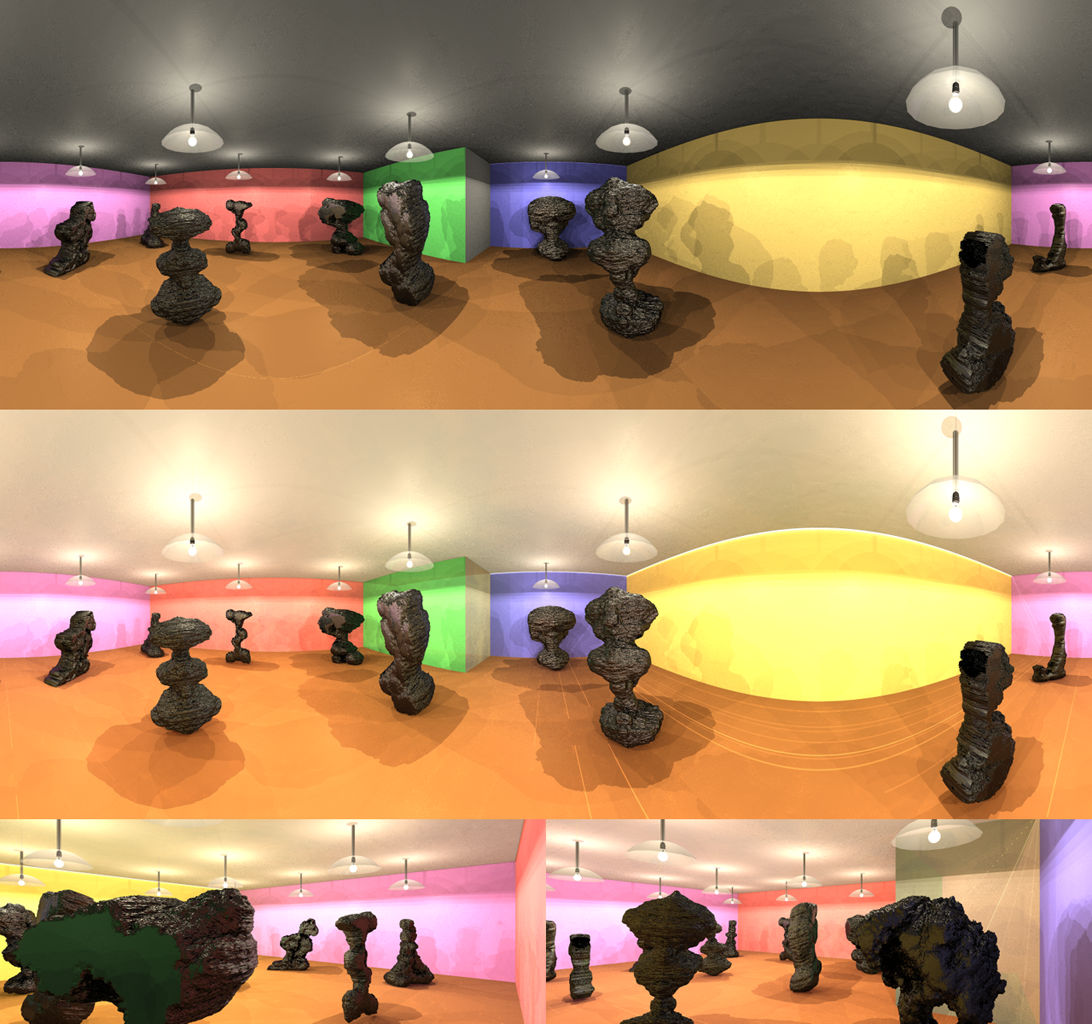
The room is made of eight 2D-faces, the rocks are from DAZ (Estevez) and the bulbs in the lamps from David. After the tests by Rashad with Bouncing Light and David with Bake Light, I present a third attempt to fake global illumination in Bryce. On top, a cylindrical panorama from the conventionally lit room. In the centre, the same panorama additionally lit by a special HDRI, lower left a 90? view from the green wall and lower right another one from the blue and yellow wall. Creating the HDRI from the room took less than 10 minutes. This includes rendering six cube faces, assembling, specular convolving and transformation into the different intermediate and final projections. The light from the HDRI enters the room through slightly transparent walls, ceiling and floor. The effect of bouncing light (evident on the rocks) can be precisely controlled by the IBL settings and wall transparencies. The light bleed-over (which is very subtle here and only evident on the ceiling) can also be precisely controlled by the Phong exponent used for the specular convolution - though this is a bit hit and miss but since this takes only 2 to 3 minutes, not really an issue. Render time is according to the number of lights and IBL settings. Using soft shadows would increase the time to render dramatically. Here, the Phong exponent used is 12, IBL quality 64, intensity 12, effect 16 and the wall transparency is 4%. The bright lines are from the light seeping through the joints of the walls, this is a Bryce bug, the lines on the floor are unaccounted for and indicate a bug as well.
Comments 4
A conversation around the artworkSign in to join the conversation.
They look like sculpted lava rocks. Nice color combination and I always like you lighting wizardry. Great test and results. :-)
This is a very good approach as I was thinking that if the walls could be used as a filter this would blend the global illumination with the inside lights with out so many cross over shadows. It is really hard to picture in this scene how the shadows and lights would interact in real life. It would be nice to have a real photo to compare it with. Would this method have some limitations when it comes to scene with only one light in the room?
Thans Rashad. I know you have the better eye for GI than I have. Check your email to get te update on this.
A very logical approach that worked out well. It looks good. The lines are not good but I probably would not have even noticed them. I think this is a very sucessful test.