FROM THE COMMUNITY COLLECTION
Method V+++
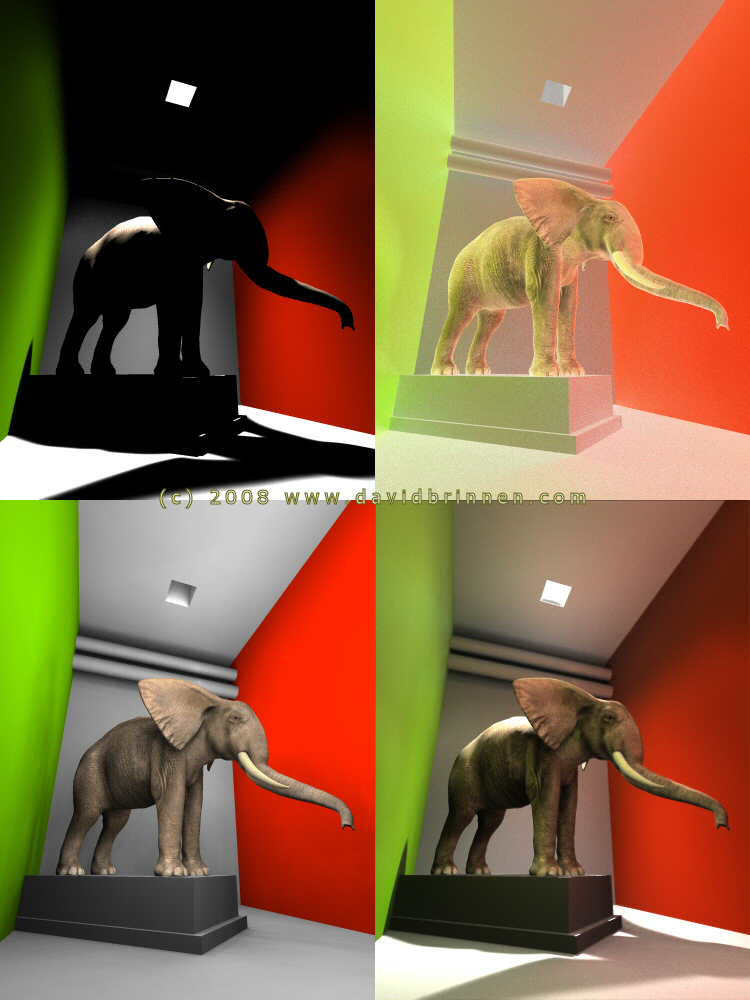
Again... a third itteration of method V but one I'm happy with. Top left is the scene as it would appear just lit by direct lighting. Top right is the scene's colour reflection map lit with a white sphere hdr provided by Horo. Bottom left is the scene's ambient map (256 random replicated weak lights). Bottom right is the culmination of these elements. The maps are applied to a filter placed in front of the camera (like the baked lights method) and the direct lighting is viewed through this filter which is lit by the ambient channel. Render time for final scene under five minutes. Ambient map about quater of an hour. Reflecion map ten minutes. So that's about half an hour for a 375x500 pixel image. Which I don't feel is too bad really for a single core P4 processor.
Comments 6
A conversation around the artworkSign in to join the conversation.
Moderately fiddly. You don't really have to grasp why it works to make it work, once it has been turned into a method, it's just a matter of performing the right steps in the correct sequence.
. sounds very complex
Yes, lots of lights. Initially I tried the method of putting the light where I thought they should go but this was too time consuming and got confusing when the number got significant. Then I tried buidling banks of lights and putting them in but this tended to create curious geometic shadows. So what I settled on is random replcating a big cube of weak lights and just putting that into the scene without much concern for if they ended up inside walls or objects. I think in the end I have had to move three lights, you can see the results of the three I have since moved just above the elephants right ear on the pipework, clearly those got too close together and too close to the pipe and created a hot spot. Because I'm thinking in terms of gathering certain types of information indipendently and then applying these to components of a material, I think of them in a similar way as the alpha map or a height map. So, reflection map is the colour bounce information gathered by using soft reflections. No shadow casting and a simple white sphere hdr is used to light the scene. Ambient map is something that should just be the light bouncing generally around the scene, without the main light, this is used to control the response of the reflecion map in the filter material so tinting and lighting areas which are recieveing most ambient light. The direct light is seen through this filter which has to be aligned accurately with the perspective camera. The directors camera is useless for this, because it has no presence in the wireframe.
. wow, I am extremely impressed with this renders, does not look like bryce at all. I am not sure what you mean by reflection map, Ambient map?
I agree with Horo, the bottom right looks awesome. I am curious what you mean by randomly placed lights, random in what sense? I think the 256 lights are doing alot of the work for you. I am only mentioning this to say that no matter how you slice it the indirect light will require additional lights, often hundreds of them. I am very impressed with the bottom right and will do my best to see what I can do along the same lines in a reasonable render time.
Well, well, well - that bottom right one looks really good. Now I must try to repeat that to see whether it is easy enough for a dumy like me. The result is certainly convincing.