FROM THE COMMUNITY COLLECTION
Al-Khima HDRI
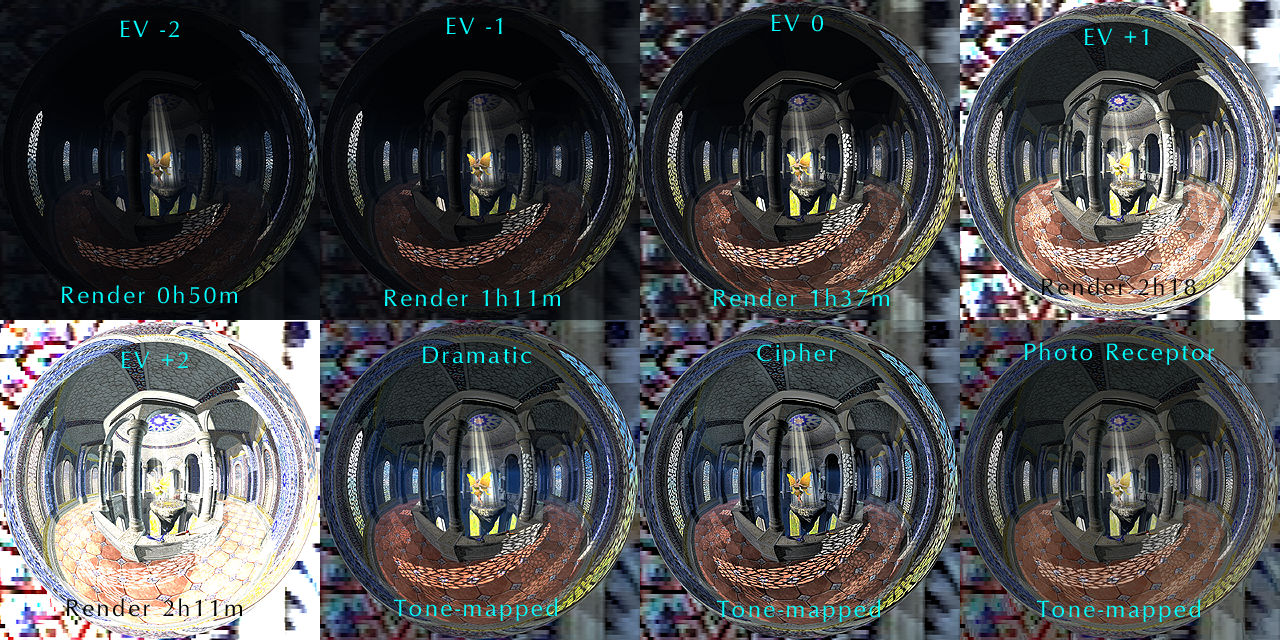
The scene was rendered 5 times using different light settings. When combining those renders to an HDRI, HDRShop 1.0.3 and Picturenaut 2.12 created cyan artefacts unaccounted for on the floor tiles. Artizen 2.6.0 beta 4 assembled them correctly with a dynamic of 16'231:1. Also Qtpfsgui 1.8.12 could assemble them, with a dynamic range of 41'845:1. The HDRI created with Artizen was twice tone-mapped in Artizen, once with the Cipher operator and once with the Dramatic one. The 10 parameters available were individually adjusted. The HDRI created with Qtpfsgui was tone-mapped in Picturenaut using the Photo Receptor Physiology operator with 5 controls. The tone-mapped pictures from Artizen were blended 50% to 50% in PhotoImpact 4, the result was blended with the picture from Picturenaut, also 50% to 50% and the mask was blended over the final picture with 67% transparency in Photoshop 6.0. See Al-Khima MB (http://www.bryce5.com/details.php?image_id=3396 ) for the final result.
Comments 2
A conversation around the artworkSign in to join the conversation.
Thanks Rashad for looking at this. David and I had discussed experiments with tone-mapped faked HDRI's. Negative EV's (exposure values) - I took the middle as reference and went down and up, simulating a "bracketed" exposure sequence. I know 22 different tone-mapping operators and each one has between 0 and 13 controls to adjust. There are an almost infinite number of possibilities how a picture can turn out (the ultimate post production). This method gives good control over ambient light, unfortunately, it lacks the colour bleeding GI would show. Render time can be excessive, depending the scene. Here, it was just 8 hours in total, the darker faster, the brighter slower. Tone-mapping needs some time, too, because of the many possibilities.
The steps taken toward the hdri assembly are very intersting. It seems that you have negative ev stops, I am curious how you set the lights during those renders. But surely the tonemapped versions are very cool. I would assume that the negative stops are really ev 0 stop with gamma lowered in post to create the negative evs? The dramatic tonemapped is my favorite, next would probably be photoreceptor. Photoreceptor seems to have retained deeper shadows. I wonder if you might do another one of these but with simpler geometry and lighting. I say this only to note that the business of the image makes me get caught up in the details and I miss the overall impression of the lighting tests. Perhaps you need a more boring subject. I am intensely interested in understanding tonemapping so please keep this stuff coming.