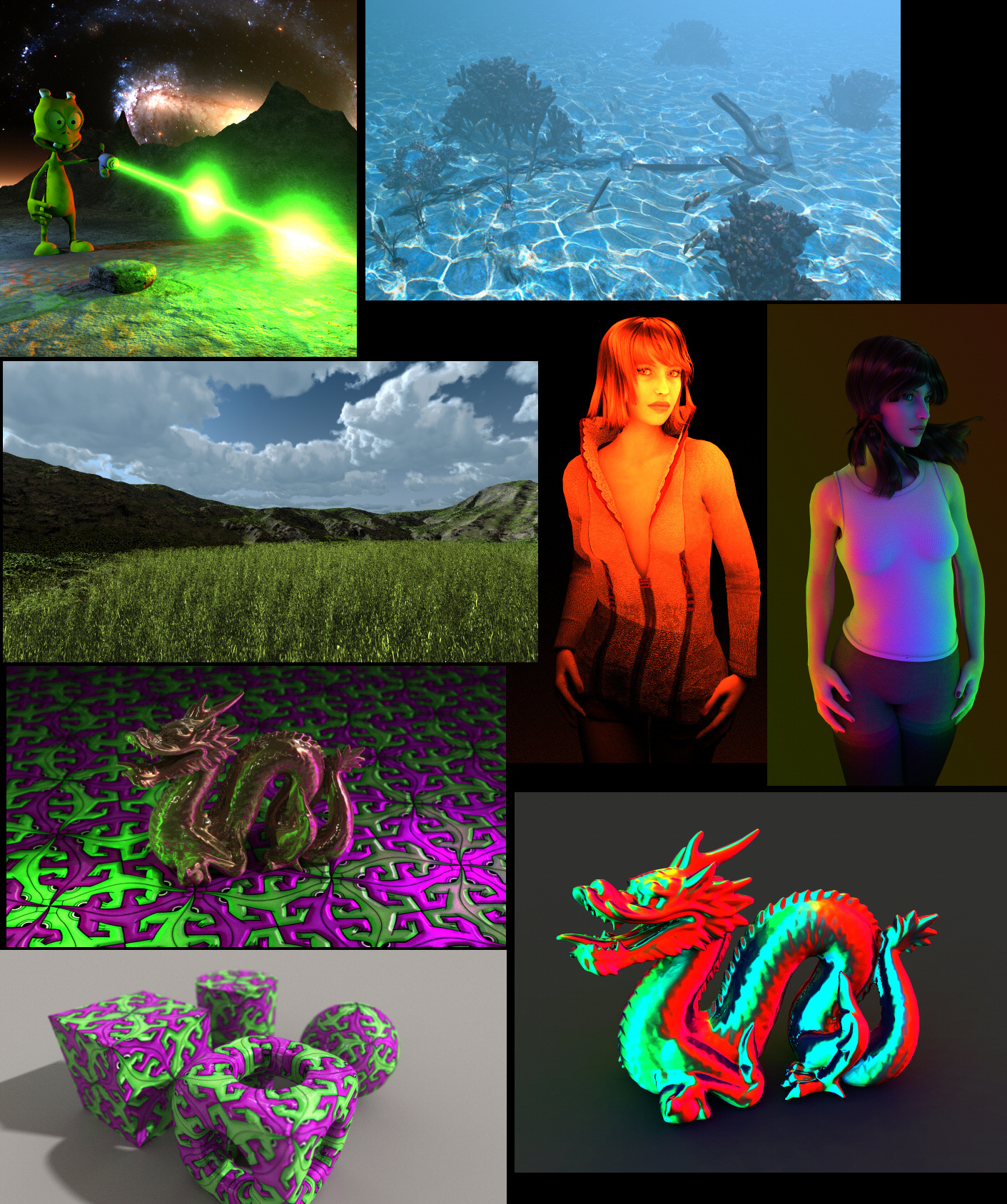
FROM THE COMMUNITY COLLECTION
Some more tutorials
<a href="http://www.youtube.com/watch?v=xm9tBbacTGQ" target="-blank">Bryce 20 minute lighting project - upgrading lighting - a tutorial by David Brinnen</a> <a href="http://www.youtube.com/watch?v=860i2_tfdtM" target="-blank">Bryce grass terrains - a 25 minute tutorial by David Brinnen</a> <a href="http://www.youtube.com/watch?v=WRYj282QUqA" target="-blank">Bryce light gel underwater effect - a 15 minute tutorial by David Brinnen</a> <a href="http://www.youtube.com/watch?v=P9TjTq-ASkM" target="-blank">Bryce "Nuts and Bolts" - object cubic and spherical mapping - a 30 minute tutorial by David Brinnen</a> <a href="http://www.youtube.com/watch?v=uQiOr4K1L0Q" target="-blank">Bryce "Nuts and Bolts" - radial lights - a 30 minute tutorial by David Brinnen</a> <a href="http://www.youtube.com/watch?v=2rN3MRh5hr8" target="-blank">Bryce 10 minute material project - rainbow texture - a tutorial by David Brinnen</a> <a href="http://www.youtube.com/watch?v=2CkC8RgxmrU" target="-blank">Bryce 10 minute material project - using the rainbow texture and scene converter - by David Brinnen</a> <a href="http://www.youtube.com/watch?v=4-o5LsuL9WI" target="-blank">Bryce "Nuts and Bolts" - TA optimised radial lights - a 40 minute tutorial by David Brinnen</a> <a href="http://www.youtube.com/watch?v=N3T1uIjNkX4" target="-blank">Getting a Little Green Man from DAZ Studio to Bryce - a 10 minute tutorial by David Brinnen</a> <a href="http://www.youtube.com/watch?v=gw96Hh1JIeY" target="-blank">Rainbow Vicky effect - a 10 minute tutorial by David Brinnen</a> <a href="http://www.youtube.com/watch?v=G3nRA4-jstc" target="-blank"> Streaming light or "God rays" effect - a 25 minute tutorial by David Brinnen</a>
Comments 5
A conversation around the artworkSign in to join the conversation.
As put on the DAZ forum (but having lost one lot of information and tutorials over there I will not trust them to loose more) Preliminary tests suggest. Caustic reflection = possible. Caustic transmission = not good. The optics for the TA feelers is amiss. My ongoing theory was that it was like âlookingâ out from the surface that is gathering the light in random directions (prodding here and there), but otherwise, it was still like looking out from the camera (but at the object surface). But⦠the feelers respond to optics in a way that is similar to the rays traced by direct light, as opposed to the rays traced by the camera. And in this case, refraction only serves to dim the rays depending on the angle of interception with the transparent surface (and the refractive value). The rays are not diverted from their path. TA probes see the rendered environment without optical refraction. Sorry to be the bearer of bad tidings.
Yes, incoming reflection becomes "real" to TA once it has become processed by another surface. Metallicity will tint any reflection with diffuse colour. I'm not sure where this is going, but it does offer a high degree of control - which is useful to some of us and distinctly off putting to the beginners. The process will have to be distilled before there will be many people prepared to put in the hours trying it out.
Sounds to me that the natural occurring internal reflection of optically transparent objects is seeing past your black sphere TA optimized radial light trick. It would actually seem consistent with your recent tests that reflections get through while diffuse light does not. I wonder if metallicity helps in this regard?
Caustics through transparency... hang on a mo... hmn... well the good news is that the TA light gathering does seem to be influenced by the refractive index of transparent materials. Render times are going to be... bad, very bad, so bad, it might still be prohibitive for anything other than simple experiments. What it has shown is that using a black gel, HDRI TA light can be excluded from an area and then "swtiched" back on by transmission through a transparent surface. More testing is needed.
Ah, more amazingness from the UK. The grass is awesome except for the anti aliasing and the blend transparency render time nightmare. The look of the grass is picture perfect so I really hope we can find a solution to the slowness of blend trans. The Caustics are nice, and I do wonder how water will fare under your newest tests regarding producing caustics with boost light on a water terrain. The darned dragon looks real, no doubt. Brilliant!